
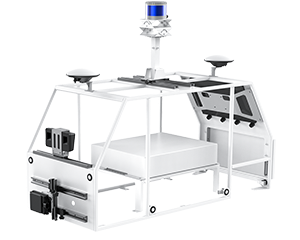

Mobile Robot Base Selection Guide: Engineering Analysis of 4 Core Drive Architectures
If you are sizing a mobile robot base (UGV/AGV/AMR platform) for an automation or embodied AI project, you have likely run into the same issue: most resources are either pure academic kinematic theory or high-level OEM product catalogs. What engineers actually need is a practical hardware trade-off guide: which drive architecture fits your target operational design domain (ODD), why, and where the engineering pitfalls lie. This guide breaks down those decisions.
1. Sizing a Base: The 3 Primary Boundary Conditions
A robotic base is far more than an off-the-shelf assembly of hub motors, caster wheels, and a lithium pack—it is the foundational locomotion subsystem of your integrated system. Sizing errors at this layer frequently cause 3 to 6 months of software tuning delays or require a ground-up mechanical redesign. Start by defining three non-negotiable parameters:
- Surface & Operating Environment: Structured indoor flooring (epoxy, polished concrete), paved outdoor roads (asphalt, pavers), semi-structured gravel, or unpaved off-road terrain?
- Gross Vehicle Weight (GVW) vs. Net Payload: The total operational payload—including sensor brackets, compute rigs, LiDARs, cabling, and custom top modules—routinely exceeds initial estimates by 20% to 40%.
- Spatial Constraints & Kinematics: What are your clear-aisle dimensions? Do your mission profiles require zero-radius pivot turns or pure holonomic/lateral crabbing?
💡 Integration Tip: Evaluate field-tested MTBF, CAN/ROS driver maturity, API documentation, and spare-parts supply chains during initial architecture freeze. Integrators frequently run into reliability bottlenecks only during final validation, incurring expensive mechanical retrofits and hardware re-sourcing.
2. The 4 Mainstream Drive Topologies: Engineering Profiles & Best Fits
Industrial and research mobile bases fall into wheeled and tracked platforms, split across four core kinematic configurations. Below is an engineering teardown covering drive principles, payload profiles, target applications, and trade-offs.
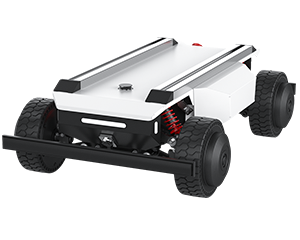
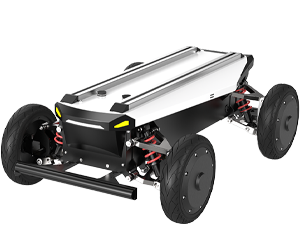
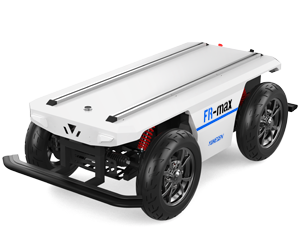
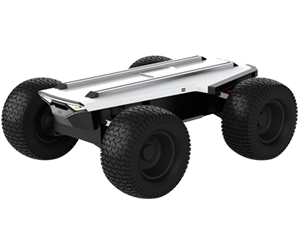
1. Ackermann Steering Platforms — High-Speed Cruising & Heavy Outdoor Payloads
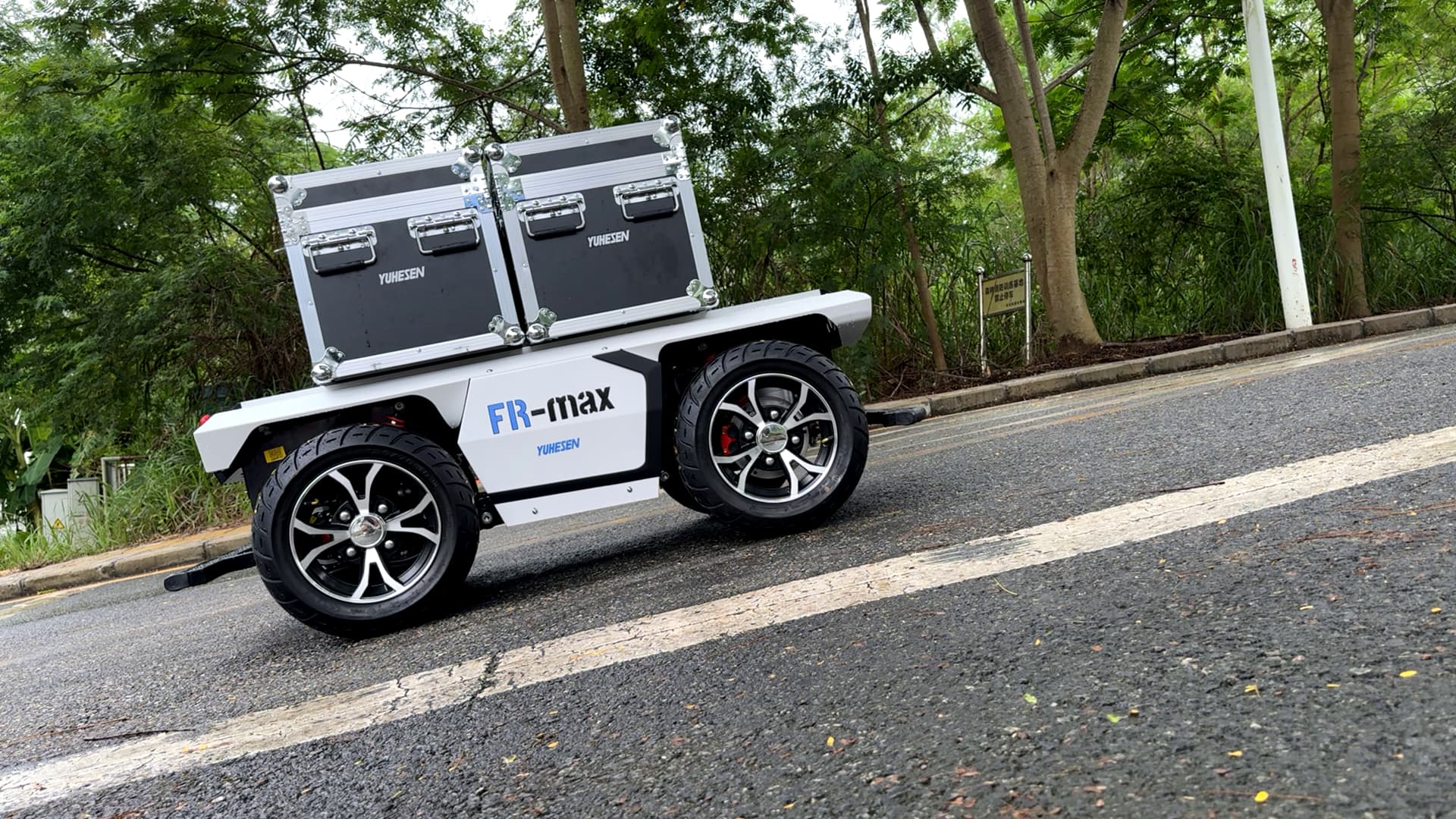
Drive Principle: Automotive-derived geometry. The front steering linkage coordinates inner and outer wheel angles around a shared instantaneous center of rotation (ICR). This delivers pure rolling contact, virtually eliminating lateral tire scrubbing and tire wear during turns. Rear-axle propulsion provides robust traction and high mechanical efficiency.
Key Advantages: High mechanical efficiency with minimal actuation units (typically steering actuator, traction motor, and service brake), automotive-grade reliability, low lifecycle maintenance (TCO), and superior high-payload capacity.
Engineering Profile:
- Rated Payload: 200 kg — 600 kg+
- Terrain: Paved roads (asphalt, concrete, pavers) and semi-structured dirt/farm roads
- Kinematics: Non-holonomic; constrained turning radius (no zero-radius pivot turns)
- Control Complexity: ★★☆ (Low to Moderate; standard automotive kinematic models)
Typical Deployments:
- Industrial Yard Logistics: 200–600 kg payload; high directional stability for long-distance outdoor transit (>1 km).
- Perimeter Security & Patrol UGVs: 100–300 kg payload; low center-of-gravity (CG) for high-speed patrol stability.
- Outdoor Heavy Inspection: 150–400 kg payload; multi-hour duty cycles on paved roadways with minimal powertrain wear.
⚠️ Engineering Pitfall: The non-zero minimum turning radius limits operations in narrow dead-end aisles. If your paths require point-turns or lateral alignment, consider a 4WD-4WS base.
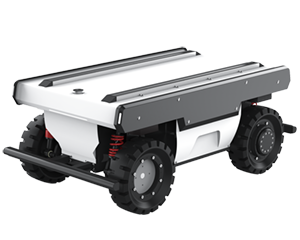
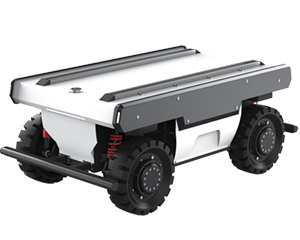
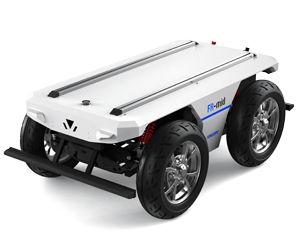
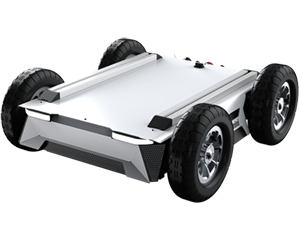
2. 4WD-4WS (4-Wheel Drive, 4-Wheel Steer) — High Maneuverability & Mixed Terrain
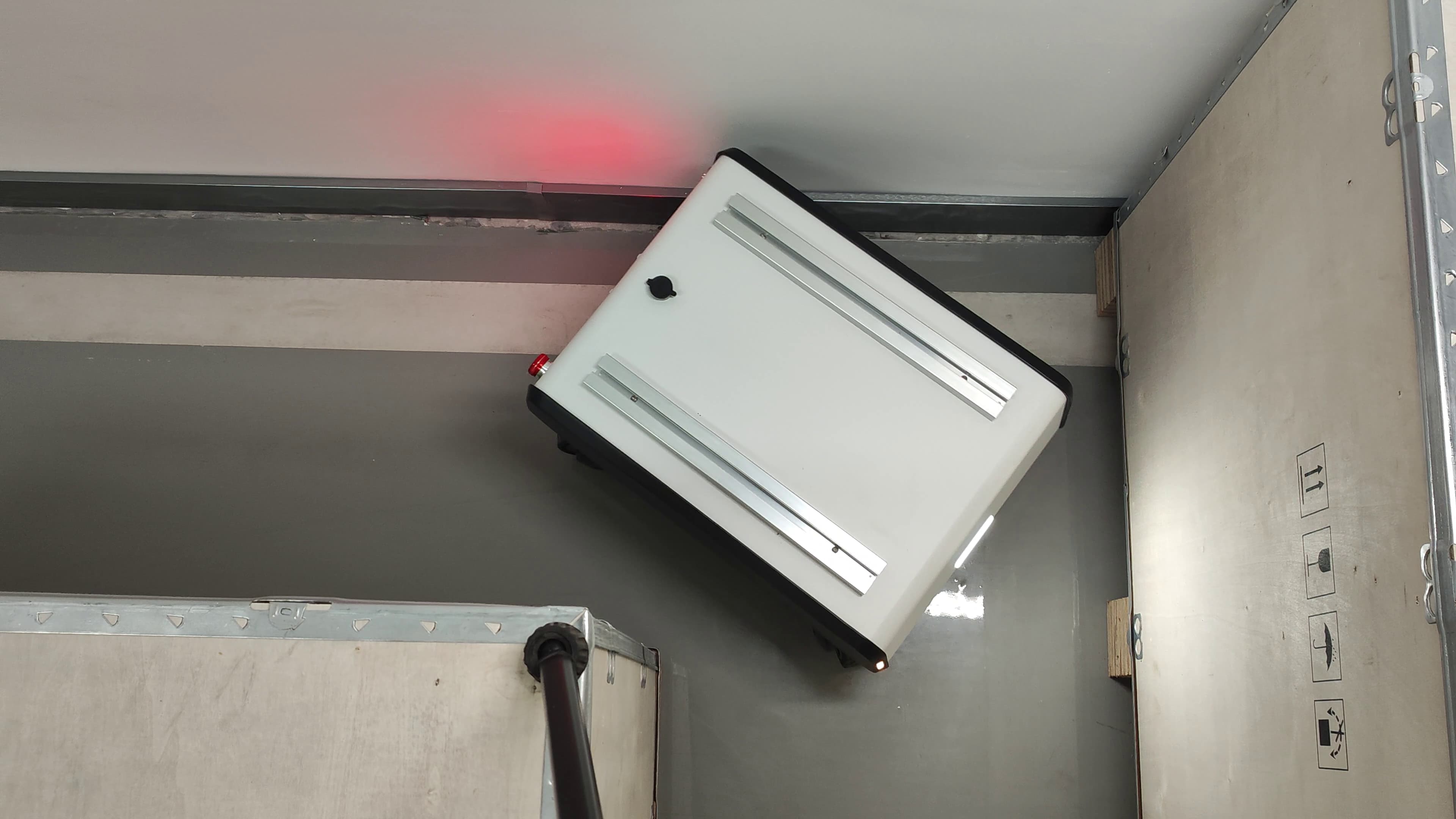
Drive Principle: Fully independent steer-by-wire and drive-by-wire on all four wheel corners. Supports four distinct multi-modal kinematic states: Ackermann mode (high-speed cruise), Crab/Diagonal steering (±90° lateral translation), Zero-Radius In-Place Rotation, and Active X-Parking (geometric wheel-lock for zero-power slope holding).
Key Advantages: High-precision trajectory execution and omnidirectional flexibility with automotive-grade durability. Unlike differential skid-steer units, 4WS maintains rolling friction across hard surfaces, eliminating tire wear and wheel hop while preserving pristine odometry for LiDAR/Visual SLAM.
Engineering Profile:
- Rated Payload: 30 kg — 250 kg
- Terrain: Indoor/outdoor transitions, paved roads, and light off-road (gravel, turf, ramps)
- Kinematics: Zero-radius pivot turning, omnidirectional/lateral planar motion
- Control Complexity: ★★☆ (Moderate; standard decoupled vector kinematics)
Typical Deployments:
- Mixed Indoor/Outdoor AMR Transit: 50–250 kg payload; seamless transitions from warehouse epoxy to outdoor yard asphalt.
- Confined-Aisle Inspection: 30–60 kg payload; crabbing sideways into tight equipment bays without reorienting the chassis heading.
- Embodied AI / VLA Mobile Manipulators: 40–250 kg payload; full Cartesian base mobility for unconstrained manipulation workspaces.
⚠️ Engineering Pitfall: For strictly open roadways where in-place pivoting is unnecessary, Ackermann platforms provide lower actuator count and simpler BOM costs.
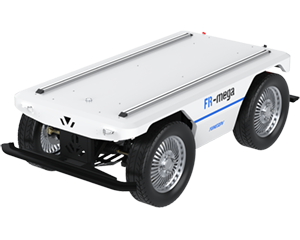
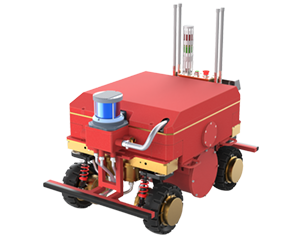
3. Wheeled Differential Drive — Standard Indoor AMR Applications
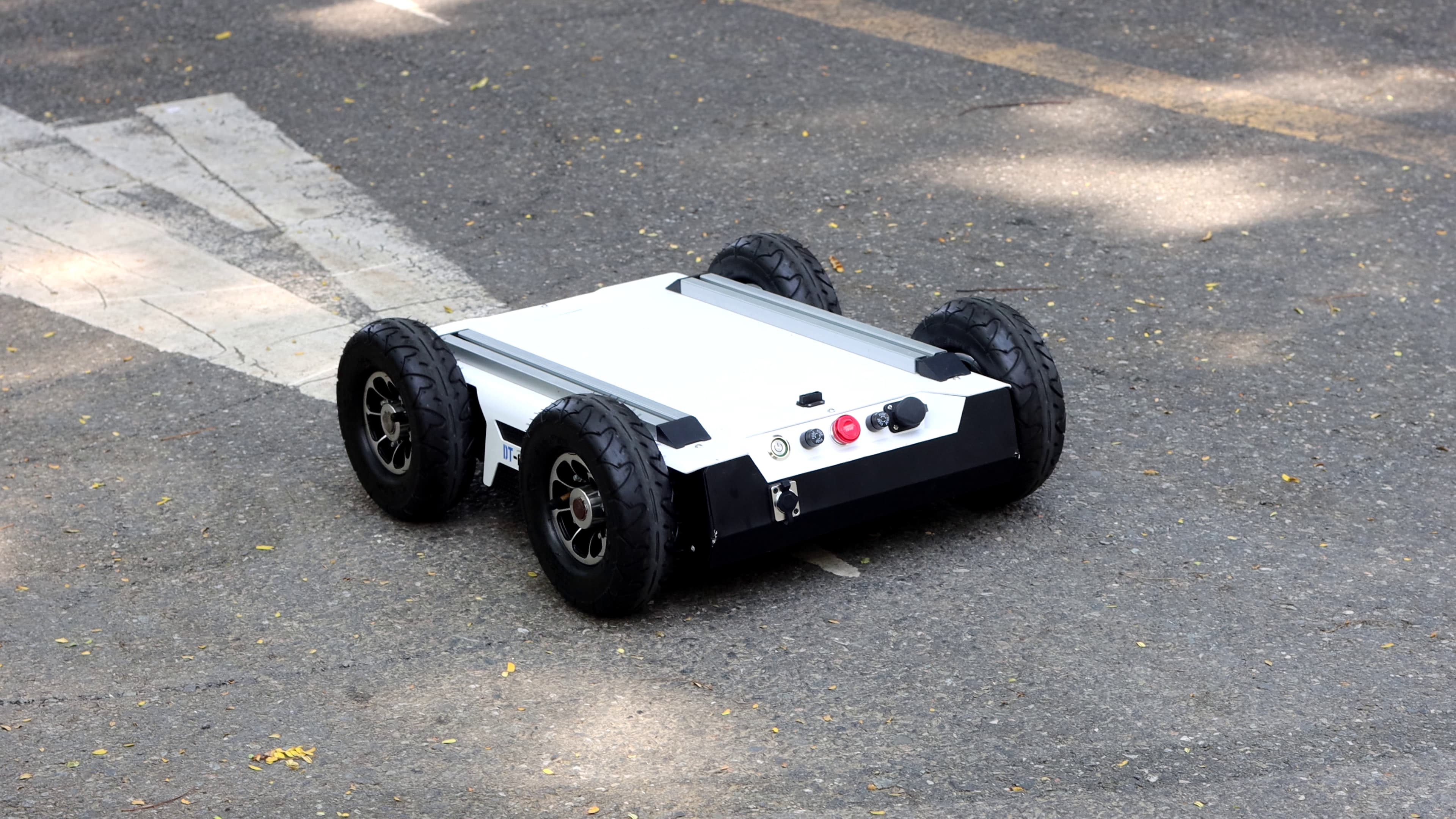
Drive Principle: Two independent drive wheels control forward velocity and yaw rate via wheel-speed differentials, supported by passive caster wheels. The kinematics and control loops are fully standardized, making this the most deployed drive type in structured indoor robotics.
Key Advantages: Lowest mechanical complexity and upfront hardware cost for smooth, flat, obstacle-free indoor environments.
Engineering Profile:
- Rated Payload: 5 kg — 500 kg
- Terrain: Level indoor flooring (epoxy, smooth concrete, commercial tile)
- Kinematics: Non-holonomic; in-place pivot turning available (no lateral crabbing)
- Control Complexity: ★☆☆ (Low; classic unicycle model)
Typical Deployments:
- Commercial Service & Delivery: 10–50 kg payload; high-volume, cost-optimized indoor fleets.
- Hospital & Facility Disinfection AMRs: 20–60 kg payload; deterministic indoor navigation.
- University R&D Kits: 5–30 kg payload; native ROS/ROS2 stack support for rapid software prototyping.
- Standard Warehouse AGVs: 100–500 kg payload; fixed-path material transport across flat logistics facilities.
⚠️ Engineering Pitfall: Performance drops sharply on thresholds, outdoor ramps, or uneven ground. Skid-steer turns cause severe wheel slip, odometry drift, floor scuffing, and thermal stress on gearboxes.
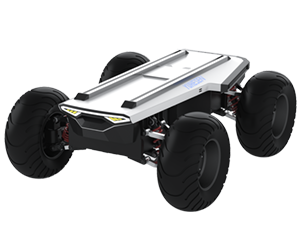
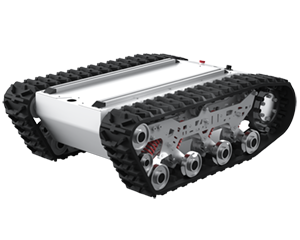
4. Tracked (Crawler) Bases — Rough-Terrain & Off-Road Field Robotics
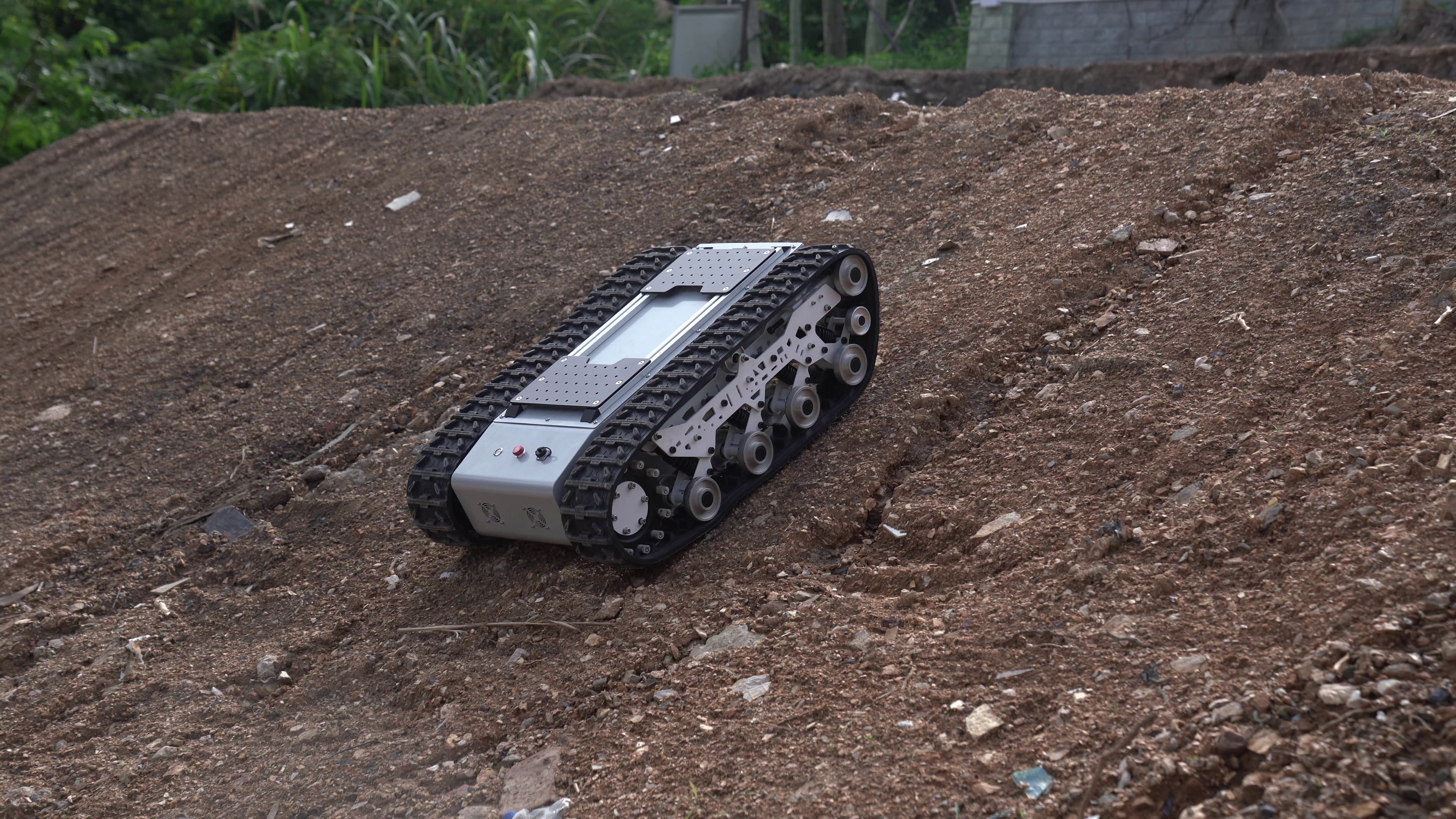
Drive Principle: Continuous reinforced rubber or steel tracks driven by heavy-duty sprockets. The large ground contact patch dramatically reduces ground pressure (PSI), enabling mobility over loose, muddy, sandy, and steep non-structural terrain.
Key Advantages: Unmatched obstacle clearance, ditch-crossing, gradeability, and traction across rough outdoor environments.
Engineering Profile:
- Rated Payload: 10 kg — 100 kg+
- Terrain: Sand, mud, snow, rubble, steep inclines (30°+ gradeability)
- Kinematics: Skid-steer differential; pivot turns on compliant surfaces
- Control Complexity: ★★☆ (Moderate; slip-ratio compensation required)
Typical Deployments:
- Smart Agriculture & Forestry: 50–300 kg payload; low ground pressure avoids soil compaction while traversing wet mud.
- HazMat & Emergency Response: 30–200 kg payload; crosses debris, standing water, and rubble fields.
- EOD & Tactical Reconnaissance: 20–150 kg payload; negotiates vertical steps and obstacles up to 2–3x higher than wheeled bases.
- Pipeline & Mining Inspection: 50–200 kg payload; rugged unpaved field mobility.
💡 Integration Tip: Tracked platforms draw 30% to 50% more power than wheeled counterparts due to track hysteresis and drive friction. Ensure your vendor provides modular quick-change track tensioners and accessible spare components.
3. Engineering Specification Matrix: 4 Drive Architectures
Direct comparison matrix across mechanical, kinematic, and operational metrics:
| Metric | Ackermann | 4WD-4WS Omnidirectional | Differential Drive | Tracked (Crawler) |
|---|---|---|---|---|
| Max Payload | 200 – 600 kg+ | 30 – 250 kg | 5 – 50 kg | 10 – 100 kg |
| Kinematic Agility | Turning radius required | Zero-radius + Lateral crabbing | Differential pivot turn | Skid-steer pivot turn |
| Terrain ODD | Paved roadways & light dirt | Indoor, paved & mixed yard | Structured flat indoor floors | Mud, sand, rubble, slopes (30°+) |
| Maintenance (TCO) | Low | Low (pure rolling friction) | High under intense outdoor pivoting | Moderate to High (tensioners/tracks) |
| Core Use Cases | Yard logistics, heavy patrol, sanitation | Embodied AI, mixed-transit, tight inspection | Indoor service, hospitality, standard AGVs | AgTech, HazMat, defense, mining survey |
4. 3-Step Selection Framework
Use this 3-step decision tree to narrow down the optimal chassis for your system requirements:
Step 1 — Identify Terrain & Operational Surface:
- Structured Indoor (epoxy, polished concrete) → Wheeled platform (Ackermann, Differential, or 4WD-4WS)
- Mixed Indoor/Outdoor Transit → 4WD-4WS or Ackermann (optimal agility-to-traction ratio)
- Paved Outdoor Roadways (asphalt, pavers) → Ackermann or 4WD-4WS
- Unstructured / Non-Paved Terrain (sand, mud, steep terrain) → Tracked base, Ackermann, or 4WD-4WS (light off-road)
Step 2 — Verify Gross Vehicle Weight (GVW):
- ≤ 80 kg (Paved) → All configurations viable; 4WD-4WS or Ackermann prioritized for agility and low maintenance
- 80 — 600 kg (Paved) → Ackermann or 4WD-4WS
- ≥ 600 kg (Paved) → Heavy-duty Ackermann base
- 100 kg (Unpaved) → Tracked base
Step 3 — Evaluate Kinematic & Spatial Constraints:
- Narrow Aisles / Dead-End Turns → 4WD-4WS (Zero-radius turning)
- Long Open Roadways / High-Speed Cruise → Ackermann (Optimized directional tracking)
- High-Precision Docking / Lateral Positioning → 4WD-4WS (Crabbing & diagonal motion)
- Extreme Off-Road & Steep Grades → Tracked Base (Differential skid-steer)
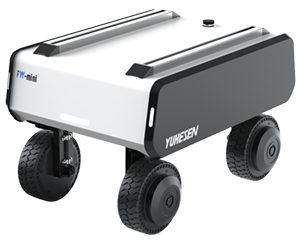
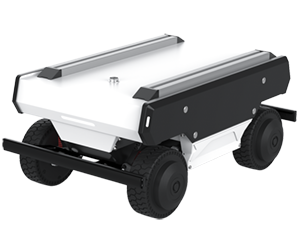
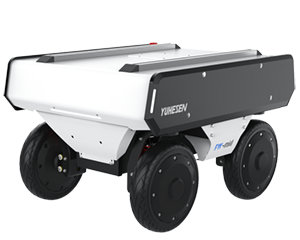
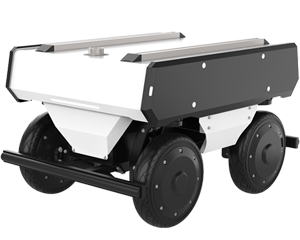
About YUHESEN
YUHESEN specializes in the R&D and manufacturing of modular mobile robot chassis (UGV/AGV/AMR bases). Our portfolio spans 4WD-4WS, Ackermann, Tracked, Differential, Explosion-Proof, and Medical-Grade platforms across 10 kg to 600 kg payload classes. Equipped with integrated navigation stacks supporting ROS 2, Baidu Apollo, and Embodied AI frameworks, YUHESEN empowers enterprise-grade automation across logistics, security patrol, chemical facilities, and healthcare robotics.
To review complete mechanical CAD models, technical datasheets, or discuss custom track/payload options, contact the YUHESEN engineering team.


